
The Formula Book 方剂
六味地黄丸 liù wèi dì huáng wán
Six-Ingredient Rehmannia Pill · from Xiao Er Yao Zheng Zhi Jue, 1119
“Three that fill, three that drain — the most elegant architecture in the pharmacy, and the tradition's definitive answer to yin running dry.” — Lao Xinglin
What's in the pot
| Herb | Role | Classical amount |
|---|---|---|
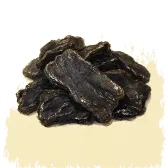 熟地黄 shú dì huáng 熟地黄 shú dì huáng |
Chief — deeply nourishes kidney yin and essence | 24 g |
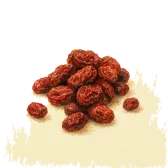 山茱萸 shān zhū yú 山茱萸 shān zhū yú |
Deputy — secures essence, nourishes the liver | 12 g |
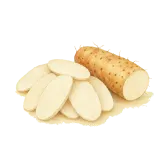 山药 shān yào 山药 shān yào |
Deputy — fortifies the spleen, banks the kidney | 12 g |
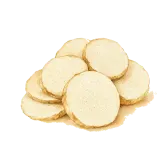 泽泻 zé xiè 泽泻 zé xiè |
Assistant — drains murky dampness from the kidney | 9 g |
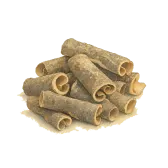 牡丹皮 mǔ dān pí 牡丹皮 mǔ dān pí |
Assistant — cools stirring deficiency-fire | 9 g |
 茯苓 fú líng 茯苓 fú líng |
Assistant — percolates damp, supports the spleen | 9 g |
The pattern it treats
Written for children by the great pediatrician Qian Yi — and adopted by everyone else for nine centuries — Liu Wei Di Huang Wan is the base camp of kidney-yin deficiency: the pattern of the body's deep reserves running dry[1]. Its signs read like an overdrawn account: sore weak lower back and knees, dizziness and ringing ears, night sweats and heat in the palms and soles, thirst at night, thinning essence in every sense. The tradition reaches for it in aging, in long illness, in the burned-out tail of overwork — wherever moisture and depth need rebuilding rather than fire needing fanning[1].
How the team works — three fill, three drain
The formula's fame is architectural. Three herbs fill: cooked rehmannia floods the kidney with yin; cornus secures what is filled; mountain yam banks it in the spleen. Three herbs drain: alisma flushes the murk that rich filling creates, moutan bark cools the flickering heat of deficiency, and fu ling keeps the middle from bogging. Fill without cloying, cool without chilling — generations of physicians learned formula design from exactly this balance[1]. A family of variants extends it: chrysanthemum and goji for the eyes (Qi Ju Di Huang Wan), and warmer or moister siblings for neighboring patterns.
What the research says
Enormously popular — it may be the best-selling classical formula in the world — but the trial literature is diffuse: many small studies across diabetes, menopause, and fatigue in Chinese journals, without the rigorous replicated trials that would support a specific claim here. We say so plainly and will update when that changes.
Where to be careful
Rich, moistening formulas sit heavily on weak digestion — the tradition withholds it where the spleen is damp and the stools loose[1]. Pattern matters as always: this fills reserves; it is the wrong tool for excess, heat, or damp conditions. Commercial teapills vary widely in quality — buy from makers who publish testing.
References
- Scheid, Bensky, Ellis & Barolet, Chinese Herbal Medicine: Formulas & Strategies, 2nd ed., Eastland Press, 2009. ↩
 Reviewed 2026-08-25