
The Herb Cabinet 本草
大枣 dà zǎo
Ziziphus jujuba · jujube date, red date
“The red date sweetens the pot the way a good host sweetens a room. Half my formulas end with the same instruction — brew with a few slices of ginger and a jujube or two.” — Lao Xinglin
What the tradition says
Da zao is the pharmacy's houseguest gift: a sweet, warm fruit that tonifies the spleen, nourishes the blood, and calms the spirit[1] — and, just as importantly, gets along with everyone. Countless classical prescriptions close with the same domestic instruction: add ginger and jujube to the pot. The pairing became shorthand for harmonizing a formula — softening harsh herbs, protecting the stomach, and marrying the defensive and nourishing layers the tradition calls wei and ying[1]. On its own it appears for the fatigue-and-pallor picture of a weak middle, and in the lovely old prescription Gan Mai Da Zao Tang — licorice, wheat, and jujube — for restless grief the classics called "visceral agitation."
What the research says
Jujube is better studied as a food than as a drug: the fruit is rich in sugars, vitamin C, and polyphenols, and laboratory work explores sedative and gastrointestinal effects — without clinical trials that would establish a medical use. Honest summary: a nourishing food with a long safety record, whose medicinal claims remain traditional.
Where to be careful
Little — this is among the gentlest drawers in the cabinet. The tradition's own caution: its sweet, cloying nature can worsen dampness — bloating, heaviness, phlegm — so the stuffed-and-sluggish should go easy[1]. The sugar content is real; people watching blood sugar should count it as the sweet fruit it is.
In the pharmacy
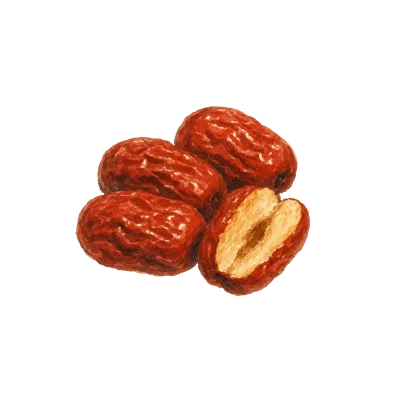
Dried fruits of Ziziphus jujuba — wrinkled, mahogany-red, honey-sweet. Grades run by size and origin; the fat Xinjiang dates are snack-counter famous. Split a few before they go in the pot so the decoction can reach the flesh.
References
- Bensky, Clavey & Stöger, Chinese Herbal Medicine: Materia Medica, 3rd ed., Eastland Press, 2004. ↩
Under the modern lens
Chemists have catalogued some 286 distinct compounds in dà zǎo. The ones their papers return to most often:
Constituent records from SymMap v2.0 and TCMSP, retrieved August 2026 and checked by hand. A list of what's inside is a map, not a promise — chemistry alone doesn't prove an effect.
 Reviewed 2026-08-25