
The Herb Cabinet 本草
菊花 jú huā
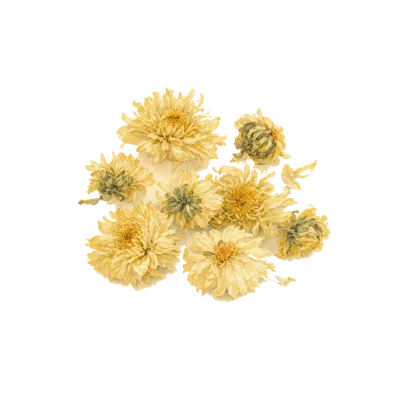
Chrysanthemum morifolium · chrysanthemum flower
“The autumn flower that cools a hot head. Red eyes, a tight brow, a long day of screens — I brew the yellow blossoms and tell people to drink it looking at something far away.” — Lao Xinglin
What the tradition says
Ju hua is autumn's contribution to the cabinet: a light, cooling flower that disperses wind-heat and brightens the eyes[1]. The classical pictures are instantly modern — red, dry, irritated eyes; headache at the temples; the scratchy first day of a heat-type cold; and the tradition's liver-yang picture of pressure rising to the head. It partners famously with mulberry leaf for early colds (Sang Ju Yin) and with gou qi zi for tired, blurry eyes — the berry nourishing, the flower clearing, a two-herb tea sold in every Chinese pharmacy[1].
What the research says
Chrysanthemum tea is consumed by the ton across East Asia, but as a medicine the flower remains traditionally attested rather than trial-proven: laboratory studies of its flavonoids explore anti-inflammatory and vision-related effects without clinical evidence to summarize. We'll update this page when that changes.
Where to be careful
- Ragweed relatives: chrysanthemum is an Asteraceae — people allergic to ragweed, daisies, or chamomile can react to it, in tea or on skin.
- Its coolness is the point and the caution: the tradition keeps it away from cold-pattern people — pale, chilly, loose-boweled[1].
- Florist chrysanthemums are not tea; drink the food-grade dried flowers.
In the pharmacy
Dried blossoms of Chrysanthemum morifolium — the small yellow-white grades for tea, the wild ye ju hua (野菊花) more bitter and colder for toxin-clearing jobs[1]. Steep, don't boil; the aroma is the medicine's gentler half.
References
- Bensky, Clavey & Stöger, Chinese Herbal Medicine: Materia Medica, 3rd ed., Eastland Press, 2004. ↩
Under the modern lens
Chemists have catalogued some 584 distinct compounds in jú huā. The ones their papers return to most often:
Constituent records from SymMap v2.0 and TCMSP, retrieved August 2026 and checked by hand. A list of what's inside is a map, not a promise — chemistry alone doesn't prove an effect.
 Reviewed 2026-08-25