
The Herb Cabinet 本草
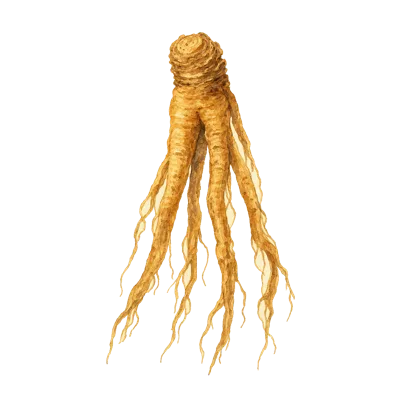
当归 dāng guī
Angelica sinensis · dong quai
“When the blood is tired, this is the first drawer my hand goes to. It nourishes and moves at once — a rare talent, and the reason they call it the women's ginseng.” — Lao Xinglin
What the tradition says
If the blood were a river, dang gui would be both rain and current: the tradition's foremost blood tonic that also moves what it builds[1]. That double talent — nourishing without congealing, invigorating without depleting — made the fragrant root the backbone of gynecology in the classical pharmacy: menstrual irregularity, scanty or painful periods, postpartum depletion, plus the general pallor-dizziness-dryness picture of blood deficiency in anyone[1]. It appears in more blood-building formulas than any other herb, from Xiao Yao San to Gui Pi Tang, and the name — "ought to return" — carries its old promise of restoring what was lost.
What the research says
Modern trials, mostly on menopausal symptoms, are inconclusive — dong quai alone has not clearly outperformed placebo[2]. Laboratory work shows more interesting signals (protective effects against chemotherapy toxicity in animal models) alongside a finding that matters for safety: extracts have shown estrogenic activity, stimulating estrogen-dependent cells in the lab[2].
Where to be careful
- Blood thinners: dang gui can add to the effect of warfarin and other anticoagulants — this combination needs a clinician's supervision[2].
- Hormone-sensitive conditions: because of the estrogenic signal in laboratory studies, people with hormone-sensitive cancers are advised to avoid it[2].
- Sun sensitivity: photosensitivity reactions are reported[2].
- Tradition adds its own caution: it moistens, so it is withheld in damp, loose-bowel patterns[1] — and, like most blood-movers, in pregnancy except under professional care.
In the pharmacy
The aromatic root of Angelica sinensis, sweet-pungent and instantly recognizable in a decoction. Classical practice distinguishes the parts — head, body, and tail — with the tail credited more with moving blood and the body with nourishing it[1].
References
- Bensky, Clavey & Stöger, Chinese Herbal Medicine: Materia Medica, 3rd ed., Eastland Press, 2004. ↩
- Memorial Sloan Kettering Cancer Center, "Dong Quai" (About Herbs monograph). https://www.mskcc.org/cancer-care/integrative-medicine/herbs/dong-quai ↩
Under the modern lens
Chemists have catalogued some 472 distinct compounds in dāng guī. The ones their papers return to most often:
Constituent records from SymMap v2.0 and TCMSP, retrieved August 2026 and checked by hand. A list of what's inside is a map, not a promise — chemistry alone doesn't prove an effect.
Used in formulas
- 逍遥散 Xiao Yao San Free and Easy Wanderer Powder Deputy — nourishes and moves the blood
- 归脾汤 Gui Pi Tang Restore the Spleen Decoction Deputy — nourishes the blood
- 补中益气汤 Bu Zhong Yi Qi Tang Tonify the Middle and Augment the Qi Decoction Assistant — nourishes the blood the qi rides on
 Reviewed 2026-08-25