
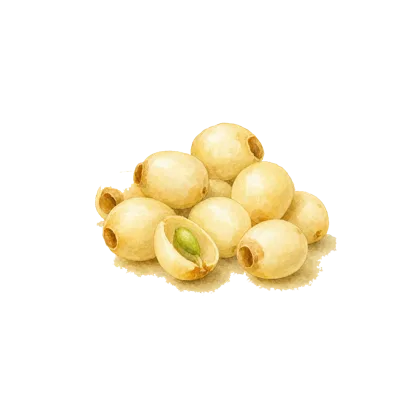
The Herb Cabinet 本草
莲子 lián zǐ
Nelumbo nucifera · lotus seed
“The lotus wastes nothing — seed, leaf, root, even the bitter green heart inside the seed. The seed itself steadies what trembles and holds what leaks. Also: excellent in soup.” — Lao Xinglin
What the tradition says
The lotus rises immaculate from the mud, and the tradition read its seed accordingly: a gentle tonic that fortifies the spleen, secures the kidney, and nourishes the heart[1]. Its verbs are all containment — stopping chronic diarrhea, holding leaking essence and discharge — and quieting: palpitations and the fretful insomnia of a heart-kidney conversation gone thin[1]. The bitter green plumule inside the seed (lian zi xin, "lotus heart") is its own small medicine, steeped alone to cool an agitated heart[1]. Between the seed, the leaf, the node of the root, and the stamen, the pharmacy files one pond plant in five drawers.
What the research says
Studied as a food — starch, resistant starch, and alkaloid work in laboratories — with no clinical trial base for the traditional indications. Lian zi's real dossier is centuries of dessert soups, eight- treasure congee, and mooncake paste; its standing is culinary-medicinal.
Where to be careful
Almost nowhere: this is food. The tradition's one line: astringents are wrong when something should still be leaving — constipation or a fresh infection isn't the moment[1].
In the pharmacy
Ivory seeds sold whole or split, heart in or out — hearts-in tastes bitterer and calms harder. Simmered until chestnut-soft; the classic partners are gou qi zi, da zao, and white fungus in the sweet soups every diaspora kitchen knows.
References
- Bensky, Clavey & Stöger, Chinese Herbal Medicine: Materia Medica, 3rd ed., Eastland Press, 2004. ↩
Under the modern lens
Chemists have catalogued some 30 distinct compounds in lián zǐ. The ones their papers return to most often:
Constituent records from SymMap v2.0 and TCMSP, retrieved August 2026 and checked by hand. A list of what's inside is a map, not a promise — chemistry alone doesn't prove an effect.
 Reviewed 2026-08-25