
The Herb Cabinet 本草
木香 mù xiāng
Aucklandia costus · aucklandia, costus root
“The pharmacy's traffic officer. Rich tonic formulas can sit heavy in a weak stomach — a little of this fragrant root keeps everything moving through the intersection.” — Lao Xinglin
What the tradition says
"Wood fragrance" is the pharmacy's great qi mover for the middle: bloating, distension, poor appetite, and griping digestive pain are its home territory[1]. Its most instructive job, though, is the one it holds in Gui Pi Tang: a small dose amid rich, sweet tonics, there to keep the feast from congealing in a weak digestion — the tradition's habit of building the brake into the engine[1]. It also regulates a knotted gut in dysenteric disorders, where moving the stuck qi eases the urgency[1].
What the research says
The root's essential oils (costunolide and friends) show gut-motility and anti-inflammatory signals in laboratory work; clinical evidence is essentially absent. One regulatory note worth knowing: aristolochic-acid scares in the 2000s involved a different plant traded under a similar name (qing mu xiang, an Aristolochia) — proper aucklandia is not an Aristolochia, and reputable suppliers distinguish them strictly.
Where to be careful
Buy from suppliers who label botanically (see above — the one real hazard is substitution, not the herb). The tradition's own limits: warm and drying, so withheld in yin-deficient heat, and dosed small[1]. CITES lists wild costus; cultivated Chinese stock is the norm.
In the pharmacy
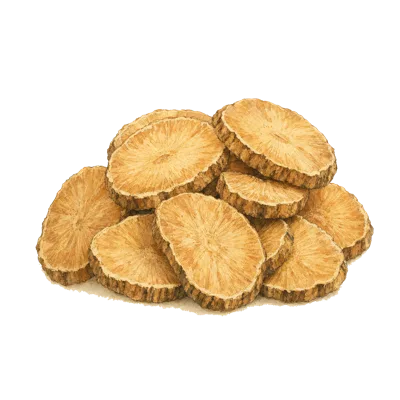
The dense, deeply aromatic root of Aucklandia costus (long traded as Saussurea costus), sliced into tan ovals that scent a whole drawer. Roasted (wei mu xiang) leans toward the intestines; raw toward moving qi broadly[1].
References
- Bensky, Clavey & Stöger, Chinese Herbal Medicine: Materia Medica, 3rd ed., Eastland Press, 2004. ↩
Under the modern lens
Chemists have catalogued some 289 distinct compounds in mù xiāng. The ones their papers return to most often:
Constituent records from SymMap v2.0 and TCMSP, retrieved August 2026 and checked by hand. A list of what's inside is a map, not a promise — chemistry alone doesn't prove an effect.
Used in formulas
- 归脾汤 Gui Pi Tang Restore the Spleen Decoction Envoy — keeps the rich tonics moving
 Reviewed 2026-08-25