
The Herb Cabinet 本草
远志 yuǎn zhì
Polygala tenuifolia · polygala, thinleaf milkwort root
“The name means "far-reaching will." The scholars' herb — for the mind that forgets, the heart that startles, and the thoughts that fog instead of flow.” — Lao Xinglin
What the tradition says
The old physiologists imagined memory as a conversation between heart and kidney — spirit above, will and essence below — and yuan zhi as the herb that keeps the line open[1]. "Far-reaching will" treats forgetfulness, palpitations with anxiety, insomnia with restless dreaming, and the disorientation the tradition attributed to "phlegm misting the heart's orifices"; it also expels stubborn phlegm from the lungs and eases angry boils[1]. In Gui Pi Tang it is the assistant that reconnects what worry has scattered — the scholar's herb in the scholar's formula.
What the research says
Polygala's saponins and oligosaccharide esters are genuinely interesting to neuroscience labs — cognition and neuroprotection studies in animals, and early-phase human work in East Asia — but no clinical evidence base yet justifies memory claims. We file the "nootropic" reputation where it currently belongs: the laboratory.
Where to be careful
More than its gentle formula-mates: yuan zhi's saponins irritate — the tradition itself flags stomach upset and prepares the root (licorice-water processing) to soften it, and withholds it in gastritis and ulcer patterns[1]. The classical texts also treat it as an herb to dose modestly and not forever.
In the pharmacy
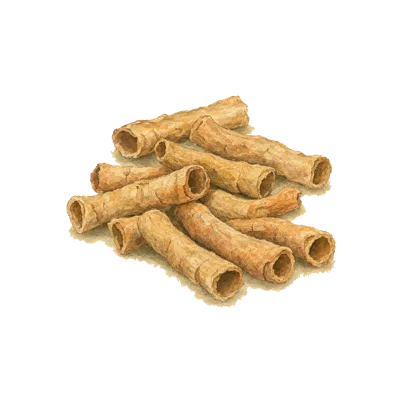
The hollow, tube-like root bark of Polygala tenuifolia, usually sold prepared (zhi yuan zhi). Thin, wrinkled, faintly acrid — a small root with a long reputation among people who lived by their memory.
References
- Bensky, Clavey & Stöger, Chinese Herbal Medicine: Materia Medica, 3rd ed., Eastland Press, 2004. ↩
Under the modern lens
Chemists have catalogued some 140 distinct compounds in yuǎn zhì. The ones their papers return to most often:
Constituent records from SymMap v2.0 and TCMSP, retrieved August 2026 and checked by hand. A list of what's inside is a map, not a promise — chemistry alone doesn't prove an effect.
Used in formulas
- 归脾汤 Gui Pi Tang Restore the Spleen Decoction Assistant — opens the heart orifices
 Reviewed 2026-08-25